
The internet returns to the person
A world where everyone is equal
Not an account. Not a profile. Not a row in someone else's database.
One key — and your entire digital life belongs only to you: identity, words, creativity, money.
This is not a concept for the future. This is an architecture we are building right now.
Scroll down

How the network itself is built
Not a website and not a company. From day one — a network of thousands of independent nodes
Web 5 does not launch as one company's service, but as a network running on the computers and devices of many independent participants around the world — from everyday users to professional infrastructure operators. Each node stores and confirms a part of the shared network history, and none of them can unilaterally alter or shut it down.
At launch the network is built from several roles working together:
Ordinary participants (validators)
user devices that confirm events on the network and earn reputation through their activity.
Processing nodes (masternodes)
more powerful participants that take on the main load of processing operations and automatically form clusters as the network grows.
Oversight and archive layer
a layer that is logically one, but physically distributed across data centres and countries, that keeps a full backup of the network and watches over its integrity — without the right to confirm or cancel events on its own.
None of these roles is assigned by decree: a node gains more responsibility automatically, under transparent rules — through stable operation, reliability, and earned reputation, not by an administrator's decision.

What this gives a person in practice
The network cannot go down as a whole — taking some nodes, or even one country, offline does not stop the rest.
No regulator, company, or attack can shut the network down with a single decision — that would require disabling a large share of independent nodes worldwide at the same time.
Any update to the network's rules goes through the consent of several independent parties — not a one-sided decision by the platform owner.
You can verify the authenticity of any event on the network yourself — you do not have to take the company's word for it, because confirmation is public and mathematically checkable.
The problem — why this matters now
The internet grew — but trust in it stayed the same
Today your identity lives in other people's databases. Your photos, messages, and documents sit on servers you do not own, under rules you did not choose. Your work can be copied in a second — and you, not the thief, will have to prove authorship afterwards. Money moves through an intermediary who can decide at any moment not to let a payment through.
We are not asking how to patch this system. We are building another one — where these problems are not fixed, but impossible from the start.
Foundation
Everything is built on one thing: one key — one identity — your entire digital world
At the core is not a login and password, but a cryptographic key that only you hold. Everything else is derived from it: signing into any service, signing any document, accessing any asset. No company, no administrator can technically reach your identity without your involvement — this is not a promise in a terms-of-use page, but a mathematical property of the system.
Lost a device? Access is restored not by a call centre or a corporation, but by people you chose yourself — under a scheme where several people you trust decide, not a single authority.
Your identity is not something that was issued to you. It is something you own.
Four pillars — how it works
One principle — four areas of life
Identity and data
Your history — sign-ins, actions, consents — is stored not in a platform table, but in your own chain, signed by you. A company can close, change hands, or come under pressure — your identity does not depend on that, because it never belonged to them.
Documents and communication
Every message, every signature is an event with two verifiable sides: sender and recipient. The content is encrypted and open only to the addressee. There is nothing left to intercept, and forging a signature means deceiving hundreds of independent network participants at once — not one company.
Creativity and copyright
The moment you publish, your work — text, photo, music, code — is signed with your key and receives irrefutable, verifiable proof of authorship. No filings with an agency. The work's NFT becomes not a speculative picture, but a working certificate of rights: licences execute automatically, and royalties from every resale return to the author on their own — without courts and aggregators taking half.
Money and assets
Payments, shares, and rights go through the same trust protocol as documents — not through a bank that decides whether to let an operation through, but through transparent rules that are the same for every participant. One sign-in — and all your assets in one place.
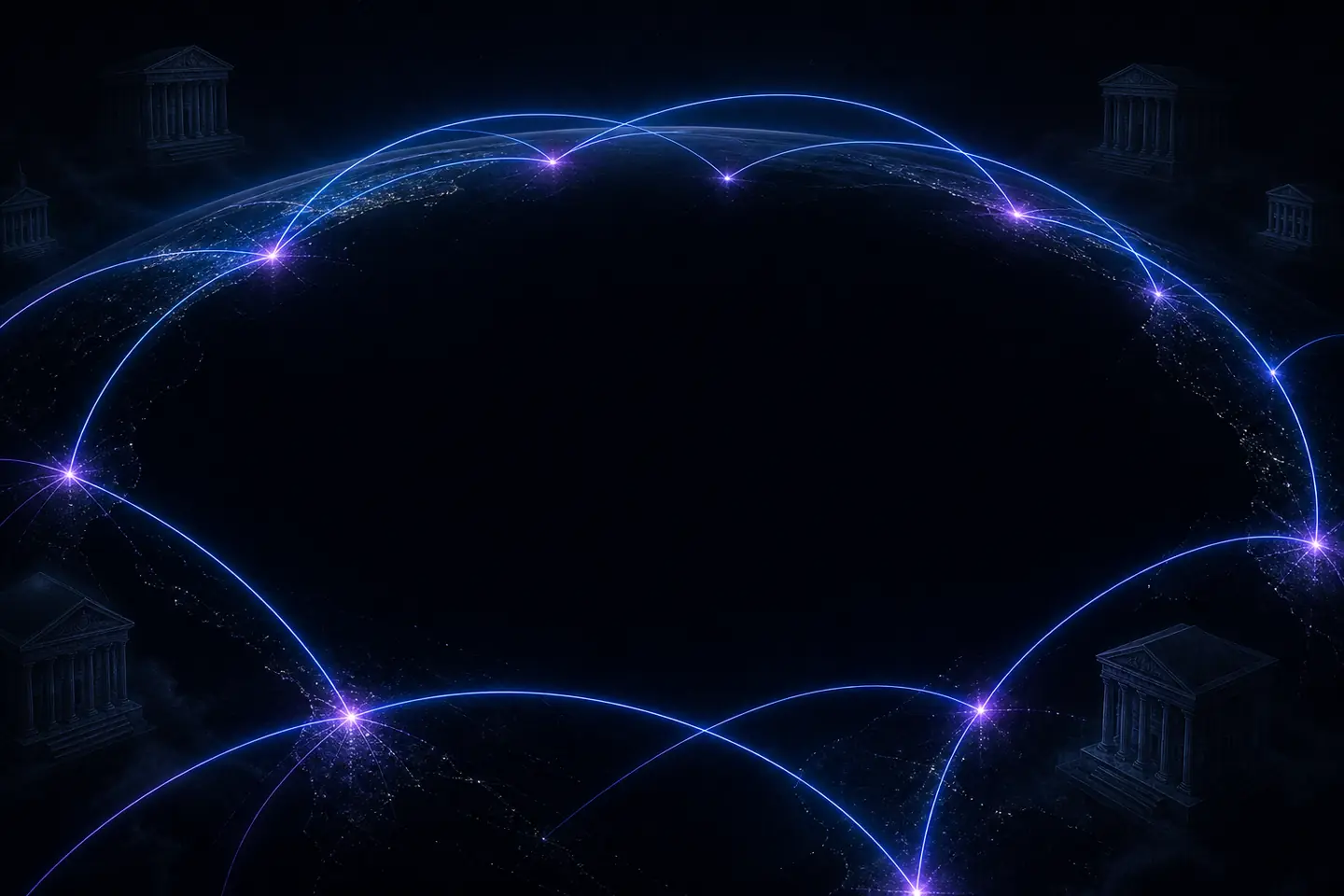
WEB bank — distributed finance
A WEB bank is not a building. It is a network
When we say “WEB bank”, we do not mean a new institution with a licence, an office, and a board of directors that you once again have to take at its word. We mean the opposite: a settlement network that in principle has no single owner, no single server, and no single place where someone else's money can be “turned off”.
No single decision centre.
Confirming a payment works the same way as confirming a document: many independent nodes around the world check the operation under the same rules for everyone. No single organisation can block, delay, or cancel someone else's transfer — because no one has administrative access to “turn off” someone else's account.
Fully decentralised financial governance.
Fees, limits, and network rules change not by the decision of one bank or platform, but by the threshold consent of several independent, separated network governors — the same way as any other update to the system's rules.
Money without borders and without a middleman on every corner.
A transfer to a person in another country goes directly over the network, not through a chain of correspondent banks, each of which takes its cut and can hold the operation for days.
Transparency without losing privacy.
Any network participant can see that the rules apply equally to everyone and that no one is given an exception — while the content and amounts of personal operations stay available only to their parties.
The same key — for signing and for paying.
The same key you use to sign a document also confirms your payment — because both actions rest on the same mathematical proof: “this was done by you”.
A bank in the usual sense is a building and a permit. A WEB bank is a protocol that cannot say “no” at its own discretion.
AI — a separate accent
Artificial intelligence that works for you — not for whoever owns the server
We deliberately build AI differently from what is common today. Not an algorithm that studies you to sell your attention to an advertiser, but an assistant bound to your personal key and working strictly in your interest.
In security
it finds fraud and anomalies on the network, but never decides alone: the last word always belongs to a person or to a transparent check.
In learning
a personal tutor that adapts to your pace, not an averaged programme, and issues digital diplomas that cannot be forged.
In health
it watches your metrics and gently suggests when to see a doctor, but the data stays with you: no clinic, no insurer gets access without your explicit and revocable consent.
In daily life
it takes on the routine: draft emails, contract checks, reminders — but any action with real consequences you confirm yourself, with your key.
The rule we do not break: AI can suggest, teach, warn, and notice — but it cannot decide or spend anything for you.
Why we are building this
Our goal is not a new product. Our goal is to give people back what was quietly taken from them
Over twenty years the internet learned to work extremely well — but not for people, for the platforms that stood between a person and their own digital life. We build Web 5 because we are sure: a person's identity, creativity, word, and money should not need a third party's permission to remain their own.
This is not about becoming “just another blockchain”. It is about changing who trust is addressed to — from a corporation to mathematics and to a network of people who bear real responsibility for every confirmation.
We measure success not by the number of users, but by a simple question: does a person in this network have more real control over their own life than they had yesterday.
Principles we do not break
- Decentralisation is built in from day one — not promised “sometime later”.
- No AI in this network is given the right to unilaterally dispose of someone else's data, money, or signature.
- Restoring access stays in the hands of the person and those they personally trust — never in the hands of one organisation by default.
- Author protection works the same for a major studio and for a person who published a single photograph.
- Ease of use matters as much as cryptographic rigour — sovereignty that is inconvenient to use returns to intermediaries.
This is not being built someday. It is being built now
Web 5 is not a manifesto for the future and not a pretty deck. It is an architecture we work on every day: layer by layer, from the personal key to a network where documents, creativity, money, and AI speak the same language of trust.
By joining this network you are not signing up for yet another service — you become part of the infrastructure that makes the digital world belong to people again.
This text describes a conceptual vision of the project and is not an investment offer, legal advice, or medical advice.